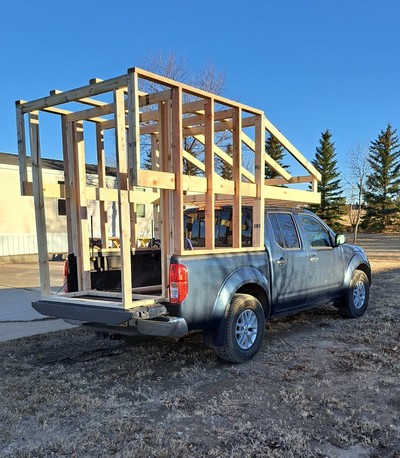
 A year ago at this time I was in the midst of completing a topper for my Nissan Frontier that began as a camper. The original plan was to build a camper first then at a later date I would build a topper, but it didn't work out that way. The camper would accommodate all four us to sleep in and was framed with 2”x4”s except for 2”x6”s on each side about half way up that extended over the cab to support the upper bunk.
Since it had a sleeping loft I felt I had to build it very sturdy, but the more I worked on it – and the more wood I added to it – the more nervous I got. It came to a climax after I finished installing the tongue & groove pine on the whole thing (except for the back which I had yet to completely frame out and build the doors for). I didn't know how much it weighed but it was a LOT, and I felt the weight would stress the Frontier. I was even more concerned about the center of gravity of the truck with the finished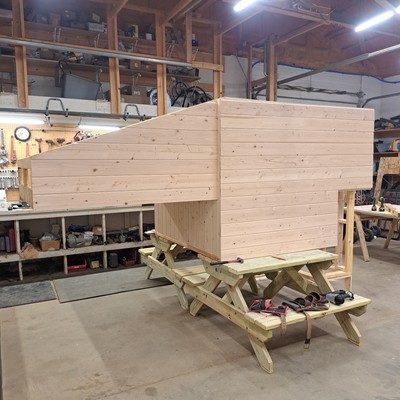 camper on it. How would it handle turns, particularly at higher speeds? Once that heavy beast went on the truck it would most likely stay there indefinitely since I didn't (yet) have a good way of removing it (good camper jacks are not cheap). I realized I jumped the shark by focusing on the camper before the topper. The topper was more practical and necessary for everyday use - the camper not so much - and I simply didn't take into account how heavy the thing would actually be.
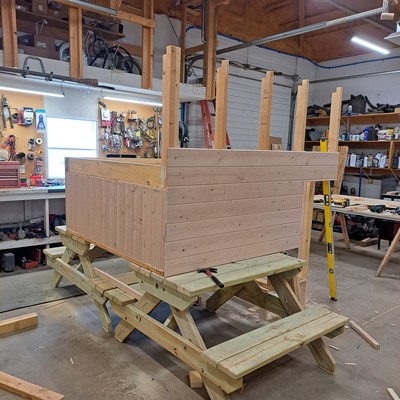 Reluctantly, I tore off the t&g, eliminated the sleeping loft, and converted the camper to a topper. After all the long hours in the shop, particularly after the kids went to bed (often from about 9pm-1am), all my thoughts, plans, and work were simplified to a very sturdy box extended out onto the open tailgate with home-made back doors. If I had started it as a topper to begin with I wouldn't have built is as robust due to the weight factor, but it's nice to know we could pitch a tent and sleep on the top of it if we wanted to. I added windows and screens to the sides to see out and provide ventilation and bug protection when camping but also as a means of supporting and lifting the topper when removing it (the windows are right below the 2”x6”s, so what I would do is open the windows and run a 4”x4” through them – the ends of which would be jacked up to remove the topper).
I was tempted to use plywood on the exterior since it would have been cheaper and faster, but wanted something more attractive so opted for t&g, liking the affect it had on my cabin in Alaska when I renovated it. The topper has served us well this past year and I definitely – hands down - made the right call in modifying the camper. However, work needs to be done to keep water out where it rests on the rails of the truck bed and the back needs to be better water and bug-proofed.
So why didn't I just buy a topper? The cost. In the end, after all the hours, lack of sleep, and money I poured into this project (particularly since it started out being one thing and became another) I 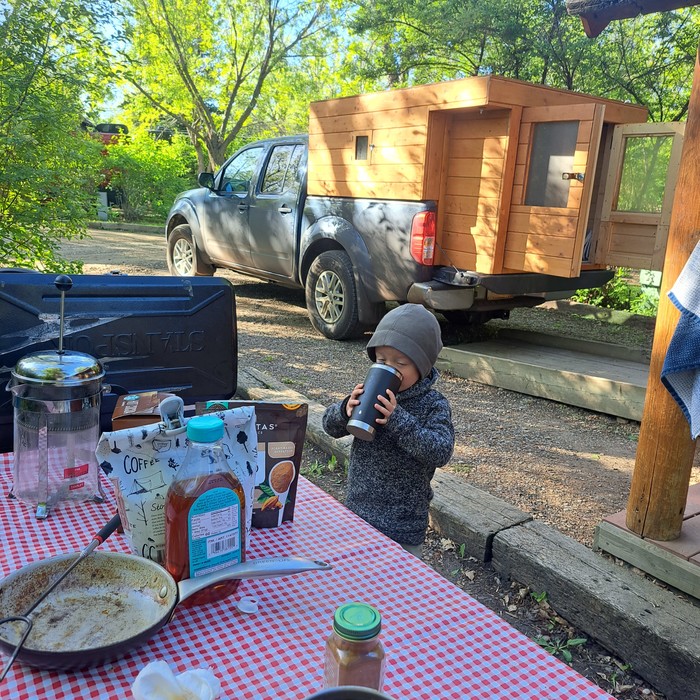 don't know that the cost/benefit really added up, but I didn't want to just buy anything and throw it on the top of my truck. Since the length of the truck bed is 5'5” it is too short to stretch out in, and I wanted to utilize the entire length of the bed with the tailgate down in order to both haul more stuff and to potentially sleep in. There is nothing on the marked that I am aware of – certainly at an affordable price – that comes close to selling what I wanted. There is also the satisfaction of creating it myself. To my disadvantage I am not an engineer type who thinks things carefully through, has detailed plans, and knows exactly what he needs but rather a trial-and-error guy who does rough sketches and tries to figure it out as I go along. But I get it done and the results have been good. It is also enjoyable to hear strangers wherever we go compliment the 'little cabin' on the back of my truck, with many men asking, “did you build it yourself?”. There is really is something admirable that we all recognize in working with ones own hands in the act of creating.
Latest Posts
Bless The Lord...
As I sat in the church pew with the boys this past Sunday, September 13, I actually tried to join the refrain “The Lord...Read more
Clueless in Gardenland 2
It is now almost mid-September and all the plants are dead or nearly so. There has been no frost, so that is not responsible....Read more
The Deacon
It had been around six months since we had last attended liturgy at our former Byzantine Catholic parish. We made a conscience decision to...Read more

- 1 of 6
- ›